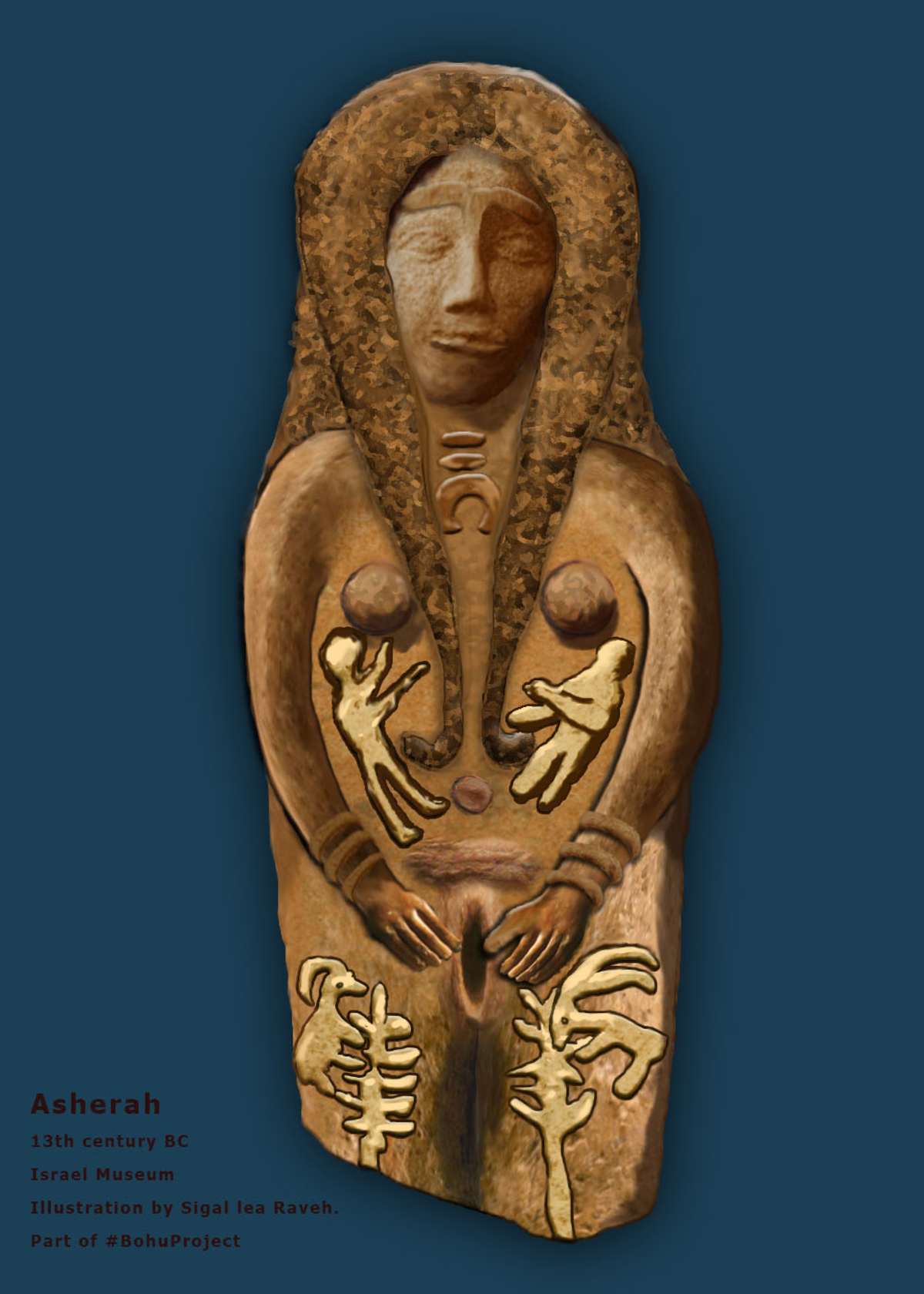
What if the Bible itself contains traces of a much more complicated understanding of the divine one in which God can be described as a mother, compared to a woman searching for something precious, and even imagined as a mother hen gathering her children beneath her wings?
And what if, behind the biblical condemnation of goddess worship, there lies the memory of an older religious world in which Yahweh may have been worshipped alongside a female divine figure known as Asherah?
These questions may sound shocking to Christians who have inherited a strongly masculine image of God. But when the Bible is read alongside archaeology, ancient Near Eastern religion, and the history of Israelite worship, the picture becomes considerably more complicated.
Perhaps the most interesting question is not simply whether ancient Israelites worshipped one God.
The deeper question is
How did ancient Israelites understand God, and how did that understanding change over time?
God in the Image of Male and Female
The first chapter of Genesis gives us one of the most fascinating theological statements in the entire Bible.
Genesis 1:26–27 declares:
“So God created humankind in his image… male and female he created them.”
If both male and female human beings are created in the image of God, then an obvious theological question follows:
Can the divine image be represented by masculinity alone?
The Bible overwhelmingly uses masculine language for God. God is called Father, King, Lord, and He. Yet the biblical tradition also contains surprisingly powerful feminine and maternal imagery.
Deuteronomy 32:18 describes God as the one who gave birth to Israel:
“You were unmindful of the Rock that bore you; you forgot the God who gave you birth.”
That is extraordinary language.
God is not merely portrayed as Israel's father.
God is associated with giving birth.
Isaiah 66:13 gives us another maternal image:
“As a mother comforts her child, so I will comfort you.”
Here God is explicitly compared to a mother comforting her child.
The Bible therefore gives us both paternal and maternal imagery for the divine.
God can be a father.
God can also be a mother.
And then we encounter one of the most memorable images Jesus ever used.
The Mother Hen
In Luke 13:34, Jesus laments over Jerusalem and compares himself to a hen gathering her chicks beneath her wings. Matthew 23:37 contains the same image.
The imagery is unmistakably maternal.
A mother bird sees danger and gathers her vulnerable children beneath her wings.
This is not the image of a distant king sitting on a throne.
It is the image of a protective mother.
Jesus could have used almost any metaphor available to him, yet he chose the image of a mother hen.
That does not mean Jesus was teaching that God is biologically female.
But it does demonstrate that maternal imagery was perfectly capable of communicating something profound about God's character.
The biblical God can be represented as father, mother, shepherd, king, warrior, woman, and mother bird.
Perhaps, then, the problem is not that the Bible lacks feminine imagery for God.
Perhaps the problem is that later Christian theology became much more comfortable emphasising the masculine imagery while leaving the feminine imagery in the background.
The Woman Searching for the Lost Coin
Jesus does something else fascinating in Luke 15:8–10.
He tells the story of a woman searching for a lost coin.
She lights a lamp, sweeps her house, searches carefully, and celebrates when she finds the coin.
The parable is part of Jesus' teaching about God's joy when what is lost is found.
Yet the character used to communicate this image is a woman.
Jesus does not say, “Imagine a king searching his treasury.”
He shows us a woman searching her home.
Again, this does not mean Jesus was declaring that God is literally female. But it does show that a woman's experience could be used to reveal something about God's character.
This matters because our images of God shape our theology.
If we only imagine God as male, then we risk assuming that masculinity is somehow closer to divinity.
But Genesis says both male and female bear the divine image.
Perhaps neither can contain God.
What About the Holy Spirit?
The question becomes even more interesting when we examine the biblical languages.
The Hebrew word commonly translated as “spirit” is
רוּחַ — ruach
Ruach can mean spirit, wind, breath, or life-giving breath. Hebrew nouns have grammatical gender, and ruach is grammatically feminine.
The Greek word used in the New Testament is the following:
πνεῦμα — pneuma
Pneuma means spirit, breath, or wind and is grammatically neuter in Greek.
This distinction is important.
It would be incorrect to argue that because ruach is grammatically feminine, the Holy Spirit must therefore literally be a woman. Grammatical gender is not the same thing as biological sex.
Nevertheless, the feminine grammatical character of ruach is interesting when placed alongside the Bible's maternal descriptions of God's activity.
Why has Christian language about the Holy Spirit become so overwhelmingly masculine when the Hebrew word itself is grammatically feminine and the biblical tradition contains such strong maternal imagery?
Perhaps the better question is not simply:
“Is the Holy Spirit a she?”
but:
“Why have Christians been so uncomfortable with imagining the Spirit through feminine language?”
And this brings us to one of the most fascinating figures in ancient Israelite religion.
Asherah.
Enter Asherah
Asherah was an important goddess in the religious cultures of the ancient Levant.
She was associated with motherhood, fertility, nature, and the divine family.
Susan Ackerman argues that Asherah, alongside Astarte and Anat, was one of the three great goddesses of the Canaanite religious world.
In the Late Bronze Age texts from Ugarit, Asherah appears under the name Athirat. Ackerman describes her as a mother goddess within a divine family. Her consort at Ugarit was El, the high god of the Canaanite pantheon.
El is portrayed as a creator,r,r, father, and patriarch.
Asherah is portrayed as a mother.r.
Their divine children form the wider pantheon, traditionally associated with seventy gods.
That is extremely important for understanding the religious world from which ancient Israel emerged.
Israel did not develop in a religious vacuum.
The Israelites lived among Canaanites and other peoples whose religious traditions included male gods, female goddesses, divine families, fertility deities, sacred trees, sacred poles, and mother-goddess traditions.
And the Hebrew Bible itself knows about Asherah.
Asherah in the Hebrew Bible
The Hebrew Bible repeatedly condemns Asherah or the asherim.
Exodus 34:13 commands the Israelites to tear down sacred pillars and cut down the Asherah.
Deuteronomy 7:5 gives similar instructions.
Judges 3:7 accuses the Israelites of abandoning Yahweh and worshipping the Baals and the Asherahs.
First Kings 18:19 refers to the prophets of Asherah during the reign of Ahab and Jezebel.
And Deuteronomy 16:21 specifically prohibits placing an Asherah beside the altar of Yahweh.
This raises an obvious question:
Why does the Bible repeatedly command people to destroy something if it was not actually part of their religious environment?
The biblical evidence strongly suggests that Asherah-related worship or symbolism existed among ancient Israelites and Judahites.
There is, however, an important scholarly debate.
In some passages, Asherah appears to refer to the goddess herself. In others, it appears to refer to a sacred object, perhaps a wooden pole, tree, or cult symbol representing the goddess.
Ellen White, writing for the Biblical Archaeology Society, emphasises precisely this problem: when we encounter the word ' Asherah' in the Hebrew Bible, we cannot always be certain whether it means the goddess, a category of divine being, or a cult symbol associated with her.
White also points out that the word appears around forty times in the Hebrew Bible and that its grammatical forms make the question more complicated than it initially appears. Archaeological evidence, she notes, has produced possible representations of Asherah as a tree, tree trunk, or other cultic symbol.
That distinction matters.
But it does not make Asherah disappear.
It makes her more fascinating.
Asherah, the Mother Goddess
White's discussion also places Asherah within the wider ancient Near Eastern world.
She notes that Asherah was known by related names, including Athirat, and that Ugaritic texts portray her as the mother of seventy divine children. The number seventy is particularly interesting because later Jewish tradition associated seventy nations with heavenly beings or angels assigned to the nations.
White also discusses proposed connections between Asherah and figures from Egyptian, Hittite, Philistine, and Arabian religious traditions, while emphasising that some of these identifications remain uncertain.
One proposed identification connects Asherah with the Egyptian figure Qudshu, whose imagery includes symbols associated with sexuality, fertility, nature, flowers, animals, and the lion. Another proposal connects Asherah with the Hittite goddess Asertu, who appears in a tradition involving Elkunirsa.
These connections should not be treated as proven identities.
But they demonstrate something important:
The divine feminine was widespread throughout the ancient Near East.
Asherah was not an isolated religious curiosity.
She belonged to a world in which female divine figures could be mothers, creators, consorts, protectors, and embodiments of fertility and life.
And then we find evidence that brings Asherah into the world of Yahweh.
“Yahweh and His Asherah”
One of the most controversial pieces of evidence comes from inscriptions discovered at Kuntillet Ajrud and Khirbet el-Qom.
The inscriptions contain the phrase commonly read as
“Yahweh and his Asherah.”
This has led some scholars to argue that Asherah was understood in popular Israelite religion as the consort or wife of Yahweh.
The evidence is fascinating, but it is also debated.
The phrase could refer to the goddess herself.
It could refer to a cultic symbol.
It could have another meaning.
Ellen White emphasises precisely this ambiguity. She notes that the expression may refer to the goddess or to the cult symbol associated with her worship.
More recent discussion of the Kuntillet Ajrud material likewise stresses that scholars disagree about the interpretation. Some have proposed that accompanying figures represent Yahweh and his goddess consort, while others identify the figures differently, including as representations of the Egyptian god Bes.
So we should not say:
“Archaeology has proven that every Israelite believed Yahweh had a wife.”
It has not.
But we also cannot simply ignore the evidence.
The inscriptions demonstrate that some ancient Israelites apparently associated Yahweh with an asherah.
And that possibility has enormous implications for our understanding of Israelite religion.
The Encyclopaedia Britannica adds another important piece to this picture.
Britannica describes Asherah as a mother goddess widely worshipped throughout Syria and Palestine. It notes that she was frequently paired with Baal, who in some traditions took the place of El, and that as Baal's consort she could be associated with the title Baalat, meaning "Lady".
But Britannica also notes something particularly significant:
Inscriptions from two locations in southern Palestine have been interpreted as suggesting that Asherah was worshipped as the consort of Yahweh.
Again, this should be treated as an interpretation of archaeological evidence rather than as an uncontested fact.
Britannica also explains that asherah in the Old Testament does not necessarily refer only to the goddess. The term can also refer to a wooden cult object associated with her worship.
This distinction is essential because it helps explain why biblical passages sometimes appear to condemn a physical object rather than explicitly naming a goddess.
The historical picture is therefore complicated.
But complicated does not mean irrelevant.
In fact, the complications are precisely what make Asherah so important.
The Bible's Attempt to Erase Asherah
The Hebrew Bible does more than mention Asherah.
It repeatedly condemns her worship.
And that tells us something.
The biblical writers were not writing about a completely imaginary religious practice.
They were engaged in a struggle against religious practices that existed within Israel and Judah.
The Biblical Archaeology Society's discussion of Asherah emphasises that the repeated biblical polemic against her cult is itself evidence that the practice had significant popularity in Iron Age Israel.
The biblical tradition records repeated attempts by kings and religious reformers to remove Asherah-related worship.
The reforms associated with figures such as Hezekiah and Josiah sought to eliminate competing cultic practices and centralise worship around Yahweh.
Yet the persistence of the practices suggests that this was not an easy battle.
The goddess, or at least her symbols, had deep roots.
This is where the gender politics of religion become difficult to ignore.
The religious establishment that eventually shaped the biblical tradition was overwhelmingly male.
And the religious practices associated with the goddess were increasingly rejected.
I would not claim that there was a conspiracy in which “men got together and decided to erase women from God.”
History is more complicated than that.
But it is reasonable to ask whether the rise of exclusive Yahwism and the development of patriarchal religious institutions contributed to the marginalisation of feminine divine imagery.
The goddess disappears from official theology.
But does the feminine itself disappear?
Perhaps not.
The Rise of Monotheism
Rather than imagining that ancient Israel began as a fully developed monotheistic society, scholars increasingly recognise that Israelite religion developed over time.
There were competing gods.
There were local cults.
There were divine families.
There were goddesses.
There were sacred trees and poles.
There were Israelites who worshipped Yahweh while participating in practices associated with other divine beings.
And there were reformers who fought to eliminate those practices.
The evidence from Kuntillet Ajrud has been particularly important in this discussion. The inscriptions appear to preserve a form of popular Yahwism that does not fit comfortably within later Jewish monotheism.
This suggests that Israelite religion may have passed through a process in which Yahweh increasingly absorbed or displaced characteristics previously associated with other gods.
Eventually, the theological system that survived insisted the following:
Yahweh alone is God.
The divine family disappears.
The goddess disappears.
The divine consort disappears.
The sacred poles are destroyed.
And feminine divine imagery becomes increasingly marginal.
But perhaps it was never completely eliminated.
Was Israel God's Wife?
This brings us to another strange feature of biblical theology.
If Asherah was removed from the religious system, what happened to the feminine role?
One answer may be found in the prophets.
Again and again, Israel itself becomes God's wife.
Israel is portrayed as an unfaithful woman.
Yahweh is the husband.
Other gods become rival lovers.
The prophetic books use marital language to describe Israel's relationship with God.
This metaphor is particularly prominent in Hosea, Jeremiah, Ezekiel, and other prophetic traditions.
But then the imagery becomes disturbing.
God is jealous.
God is angry.
God punishes the wife.
And the children suffer.
Was God an Abusive Husband?
Dvora Lederman Daniely reads the imagery of Lamentations through the lens of a violent and deeply troubled marital relationship.
Lamentations describes Jerusalem as a woman who has fallen from greatness and become like a widow. Her enemies dominate her. Her children are carried away. She describes the agony that has been inflicted upon her and attributes her suffering to the Lord's actions.
Daniely argues that the imagery can be read as something resembling a violent marital relationship: Yahweh appears as an angry and jealous husband, while Israel is represented as the wounded wife and her children become victims of the conflict.
This is an intentionally provocative interpretation.
It forces us to look at biblical imagery that we often read so quickly that we fail to notice how disturbing it can be.
The woman is suffering.
Her children are suffering.
Her husband is angry.
And the suffering is explained through the language of divine jealousy and punishment.
Of course, Lamentations is not literally telling us that Yahweh physically beat a goddess.
It is poetic literature describing the catastrophe of Jerusalem.
But the metaphor is still powerful.
And if we place that metaphor alongside ancient traditions concerning a divine mother or consort, another possibility emerges.
Perhaps the feminine divine role that once belonged to a goddess was gradually transferred to Israel itself.
The goddess disappears.
The nation becomes the wife.
And Yahweh remains the husband.
That is a patriarchal theological transformation.
The Goddess Disappears: But the Mother Returns
If the ancient goddess was pushed out of Israelite theology, perhaps the feminine did not disappear so much as change form.
And this brings us to Christianity.
Because Christianity does something fascinating.
The goddess disappears.
But the mother returns.
Her name is Mary.
Mary and the Return of the Divine Feminine
Roman Catholic Christianity gives Mary an enormous place in Christian devotion.
Mary is venerated as the Theotokos, meaning “God-bearer” or traditionally “Mother of God".
Eastern Orthodox Christianity likewise gives Mary extraordinary importance and places the title Theotokos at the heart of its theology and worship.
Mary is also deeply honoured in the Oriental Orthodox traditions, including the following:
- Coptic Orthodox Christianity
- Syriac Orthodox Christianity
- Armenian Apostolic Christianity
- Ethiopian Orthodox Tewahedo Christianity
- Eritrean Orthodox Tewahedo Christianity
Mary is also honoured in parts of the Anglican Communion, especially Anglo-Catholic traditions, and commemorated within some Lutheran traditions.
The degree of Marian devotion varies enormously among Christians.
But the basic point remains:
Christianity did not completely eliminate the sacred feminine.
Instead, Christianity gave an extraordinary place to the Mother of Jesus.
Mary became a mother.
Mary became Queen.
Mary became an intercessor.
Mary became the woman through whom God entered human history.
For millions of Christians, Mary became one of the most important figures in the entire Christian story.
And this makes me ask one fascinating question:
Did Christianity preserve some of the functions once associated with the ancient divine feminine by transferring them to Mary?
I am not saying that Mary is secretly Asherah.
Catholic, Orthodox, and mainstream Christian theology does not teach that Mary is a goddess. Christians who venerate Mary distinguish that veneration from the worship owed to God.
But from the perspective of religious history, the prominence of a sacred mother figure is fascinating.
The feminine did not disappear.
It was relocated.
What If God Is a Woman?
None of this proves that God is literally a woman.
But it does challenge the assumption that God must be understood as exclusively male.
Genesis says male and female are both created in God's image.
Deuteronomy describes God as giving birth.
Isaiah compares God to a mother comforting her child.
Jesus uses the image of a mother hen.
Jesus tells a story about a woman searching for something lost as an image of God's searching and rejoicing.
The Hebrew word 'ruach' is grammatically feminine.
And ancient Israel existed in a religious world in which female divinity was a significant part of the religious imagination.
So perhaps we should stop asking the following:
“Is God male or female?”
and start asking:
“Why do we assume that God must fit into either category?”
Perhaps God transcends gender.
Perhaps the masculine and feminine are both reflections of something greater.
Perhaps “Father” is true.
Perhaps “Mother” can also be true.
Does the Trinity Need a Feminine Dimension?
This is where I want to move beyond historical reconstruction and openly state my own theological position.
I believe Asherah should have a place in the conversation about the Trinity.
I understand that many Christians would strongly reject this.
Traditional Christianity understands the Trinity as Father, Son, and Holy Spirit, and introducing Asherah into the Trinity would be viewed by most Christians as incompatible with orthodox Christian doctrine.
I understand that objection.
But I also believe theological traditions can be questioned.
If ancient Israel once contained traditions concerning a divine mother or consort, if the Bible itself contains maternal imagery for God, and if feminine divine imagery appears repeatedly throughout the biblical tradition, then I believe Christians are justified in asking whether something has been lost.
Perhaps Asherah should not be understood simply as a “false goddess".
Perhaps she can be reconsidered as a symbol of a divine feminine dimension that was marginalised as Israelite monotheism developed.
And perhaps, for some Christians, this could lead to rethinking the Trinity itself.
I am not saying that every Christian must accept Asherah.
I am not saying Catholic, Orthodox, Protestant, or other Christians must abandon their existing theology.
I am saying that there should be room for Christians who believe that God is beyond male and female and who nevertheless believe that the divine feminine deserves a place within Christian theology.
For me, Asherah raises that possibility.
Perhaps the Father represents the masculine imagery of God.
Perhaps the Son represents God entering human history.
Perhaps the Holy Spirit represents God's living presence.
And perhaps the ancient memory of Asherah points toward a feminine dimension of the divine that Christianity has forgotten.
That would be a radical rethinking of the Trinity.
But perhaps radical theological questions are sometimes necessary.
God Beyond Male and Female
There is another possibility.
Perhaps God is neither male nor female.
Perhaps God is beyond gender altogether.
If humanity, male and female, is created in God's image, then perhaps God cannot be reduced to either sex.
A male human being reflects something of God.
A female human being reflects something of God.
Neither one contains God.
This understanding could actually make room for both masculine and feminine language without requiring us to turn God into a biological male or female.
God can be a Father.
God can be a mother.
God can be described through the imagery of a woman.
God can be compared to a mother bird.
God's Spirit can be ruach.
And perhaps the divine feminine can be represented symbolically through figures such as Asherah without requiring Christians to believe that God literally has a female body.
This possibility may be especially important for Christians who are uncomfortable with the idea of adding Asherah to the Trinity but nevertheless believe that God transcends human gender.
There may therefore be several possible theological responses:
God is male.
God is female.
God is beyond male and female.
Or perhaps:
God transcends gender while containing both masculine and feminine dimensions.
Was Abrahamic Religion Always Meant to Be Monotheistic?
The history of ancient Israel also complicates the common assumption that the Abrahamic religious traditions emerged as fully developed monotheisms from the beginning.
The archaeological and textual evidence presents a much messier picture.
There were competing gods.
There were divine families.
There were goddesses.
There were sacred trees.
There were sacred poles.
There were local cults.
There were Israelites who worshipped Yahweh while also participating in practices associated with other divine beings.
And there were reformers who fought fiercely to eliminate those practices.
The emergence of monotheism can therefore be understood as a long historical and theological development.
The Bible itself preserves traces of that struggle.
Its writers were not merely describing a world in which everyone already agreed about God.
They were arguing.
They were condemning.
They were reforming.
They were trying to define what worship of Yahweh should mean.
And perhaps that is why the Bible is so fascinating.
It is not simply the record of one unchanging religious system.
It is also the record of a religious transformation.
The Patriarchy and the Divine Feminine
This brings me to one of the strongest conclusions of this exploration.
I believe patriarchy played an important role in shaping how the divine was represented.
That does not mean every biblical writer deliberately tried to erase women.
Nor does it mean that the history of monotheism can be reduced to “men destroyed the Goddess".
History is more complicated.
But the religious institutions that shaped the biblical tradition were overwhelmingly male.
The priesthood was male.
Political leadership was overwhelmingly male.
The literary establishment was male.
And the God-language that became dominant was overwhelmingly masculine.
Meanwhile, the goddess and her symbols were increasingly condemned.
That historical pattern deserves attention.
The question is not simply:
“Did patriarchy invent monotheism?”
The more interesting question is the following:
“How did patriarchal societies influence which images of God survived and which were rejected?”
That question is worth asking.
Recovering the Divine Feminine
Perhaps Christians do not need to abandon monotheism in order to recover the feminine.
Perhaps the feminine can be recovered from the Bible itself.
God gives birth.
God comforts like a mother.
God gathers children like a mother hen.
Jesus tells a story about a woman searching for something precious.
Humanity is created male and female in God's image.
The Hebrew ruach is grammatically feminine.
Mary becomes the Mother of God in Catholic and Orthodox theology.
And beneath all of this lies the archaeological shadow of Asherah.
The Goddess may have been condemned.
The sacred poles may have been cut down.
Her worship may have been suppressed.
But the feminine did not disappear.
It survived.
It survived in biblical metaphors.
It survived in maternal imagery.
It survived in the Spirit.
It survived in Wisdom.
It survived in Mary.
And perhaps it survived in the human longing to imagine God not merely as a distant male ruler but as the Mother who gives birth, protects, searches, comforts, and gathers her children home.
So, Was God Ever Imagined as a Woman?
Perhaps the answer is more complicated than yes or no.
The Bible does not explicitly teach the following:
“God is a woman.”
Neither does archaeology prove:
“Yahweh definitely had a wife named Asherah.”
Those statements go further than the evidence allows.
But the evidence does show something fascinating.
Ancient Near Eastern religion contained powerful female deities.
Asherah was a major mother goddess.
Ancient Israel knew about Asherah.
The Hebrew Bible repeatedly condemns her or her cult symbol.
Archaeological inscriptions contain the controversial phrase “Yahweh and his Asherah".
Scholars continue to debate exactly what that phrase means.
And the emergence of exclusive Yahwism appears to have occurred within a religious world that was much more diverse than later monotheism suggests.
At the same time, the Bible itself never completely loses feminine imagery for God.
The mother is still there.
The woman is still there.
The mother hen is still there.
The birth-giving God is still there.
The feminine spirit language of ruach is still there.
And later Christianity gives extraordinary importance to Mary.
So perhaps the real question is not simply the following:
“Is God a woman?”
Perhaps the deeper question is the following:
“What parts of God have we forgotten because we have insisted on imagining God primarily as male?”
The Mother We Forgot
Maybe the divine feminine was never truly destroyed.
Maybe it was buried beneath centuries of theology.
Maybe it survived in the shadows.
Maybe Asherah became a forbidden memory.
Maybe Israel became the wife.
Maybe Mary became the Mother.
Maybe the Holy Spirit became the mysterious feminine presence that could not quite be eliminated.
And perhaps this is why the question still refuses to disappear.
I believe God may be greater than the categories of male and female.
I believe both men and women bear the image of God.
I believe the Bible gives us legitimate maternal imagery for God.
I believe the historical evidence concerning Asherah deserves to be taken seriously, even where the evidence remains disputed.
And I believe Christians should at least be willing to ask whether the divine feminine has been marginalised by centuries of patriarchal theology.
For me, that raises an even more radical theological possibility:
Perhaps Asherah deserves a place in the Christian conversation about God.
Not because archaeology has proved every detail of the ancient Israelite religion.
Not because Christianity traditionally teaches that Asherah belongs in the Trinity.
It does not.
But because the history of religion is more complicated than our inherited categories.
Perhaps some Christians will reject Asherah entirely.
Perhaps others will see her only as an important historical deity.
Perhaps others will understand her symbolically as an expression of the divine feminine.
And perhaps there will be Christians who are willing to imagine something even more radical: a God who transcends gender while containing both masculine and feminine dimensions and a divine reality in which the feminine has a place alongside the Father, Son, and Holy Spirit.
That is my theological question.
And perhaps it is worth asking.
Because if both male and female are created in the image of God, then maybe neither “He” nor “She” can contain the divine.
Maybe God is bigger.
Maybe God is both.
Maybe God is neither.
Maybe God is beyond all of it.
But perhaps the most important thing is this:
The mother belongs in the conversation.
And maybe after centuries of pushing the feminine divine into the shadows, it is time to bring her back into the light.
And for me God is a woman and Asherah should be part of the Holy Trinity
But the patriarchal religion may consider this blasphemous and unchristian-like.
But perhaps we need to be blasphemous and unchristian-like to bring back the goddess and the feminine divine, as we are doing the divine a disservice by embracing and sticking to the patriarchal religious definition of God and who God is!
References
Ackerman, Susan. "Asherah/Asherim: Bible." Shalvi/Hyman Encyclopedia of Jewish Women. 27 February 2009. Jewish Women's Archive. (Viewed on August 14, 2026) <https://jwa.org/encyclopedia/article/asherahasherim-bible
Britannica Editors. "Asherah". Encyclopedia Britannica, 11 Jun. 2026, https://www.britannica.com/topic/Asherah-Semitic-goddess. Accessed 14 August 2026.
Lederman, Daniely, D. 2022. “Who’s Afraid of the Goddess of Ancient Israel?” The Ancient Near East Today 10.6. Accessed at: https://anetoday.org/lederman-daniely-goddess/
White, Ellen. "Asherah and the Asherim: Goddess or Cult Symbol?" Biblical Archaeology Society, 4 Nov. 2014, www.biblicalarchaeology.org/daily/ancient-cultures/ancient-israel/asherah-and-the-asherim-goddess-or-cult-symbol/.
Further Reading
Downey, April Lynn. "Asherah." World History Encyclopedia, 29 Sep 2020, https://www.worldhistory.org/Asherah/.
Scham, Sandra. "The Lost Goddess of Israel." Archaeology, vol. 58, no. 2, Mar./Apr. 2005, archive.archaeology.org/0503/abstracts/israel.html
Links to view
"Did God Have a Wife?": The Bible's Buried Secrets. BBC, March 16, 2011. Video clip, 2:00. https://www.bbc.co.uk/programmes/p00fpxmc.
History Valley. "God's Wife with Francesca Stavrakopoulou." Video, March 7, 2024. https://www.youtube.com/watch?v=QbXg10c-mh4.
MacDonald, Nathan. "Asherah." Bible Odyssey, Society of Biblical Literature, www.bibleodyssey.org/video-gallery/asherah/.
Photo credit: Israel Museum https://www.imj.org.il/he/collections/198014 ; See The Figurine from Revadim—Wet-nurse or Child-bearing Woman? / הצלמית מרבדים — מינקת או יולדת?